Hey everyone, I’m Jake, and for the last 8 years, I’ve been deep in the weeds as a dry oil-free screw air compressor supplier—talking to factory managers, maintenance techs, and plant operators who need reliable, zero-contamination air day in and day out. One question I get more than any other (right after “how do I know I’m getting a real oil-free unit?”) is this: do these compressors even need a belt? And if so, what does that belt actually do? Most people assume big industrial compressors run directly off a motor or something, but nope—belts are way more important here than you’d think, especially for the dry oil-free ones I sell. Let’s break this down without the boring engineering jargon that makes most specs sheets unreadable. Dry Oil Free Screw Air Compressor

First, let’s get on the same page about what a dry oil-free screw air compressor actually is, quick. Unlike oil-flooded units that douse the screws in lubricant to seal, cool, and reduce friction, these bad boys have zero oil in the compression chamber. That means they’re the go-to for anything where even a tiny oil mist would ruin a product: food and beverage packaging, pharmaceutical manufacturing, electronics assembly, automotive paint booths, even breathing air systems for confined space work. No oil = no risk of contamination, which is why every part of these units is built to be precise. So why mess with a belt here? Why not connect the motor straight to the screw end?
That’s the first thing I explain to customers who ask about belts: the belt is the unsung middleman between two parts that have to work together perfectly, but can’t be bolted directly. Let’s start with the motor side. Most industrial compressors run on 3-phase electric motors, right? These motors have a set RPM (rotations per minute) at their optimal efficiency—usually around 1,500 or 1,800 RPM for big units. The screw element, that two-part metal rotor that squeezes air, doesn’t run at that same speed at all. To compress air properly, the screws need to spin much slower—usually between 1,000 and 2,000 RPM, depending on the size of the element. If you connect the motor straight to the screw, you’d spin the screws way too fast; they’d overheat, wear out in months, or even seize up entirely. The belt is what adjusts that speed. It’s a simple gear ratio, basically: a smaller pulley on the motor, a bigger pulley on the screw end, so the motor’s high RPM gets turned down to the slow, steady speed the screw needs. That’s job number one, no questions asked.
But wait, it’s not just speed matching. Dry oil-free screw elements are way more sensitive to misalignment than oil-flooded ones. Because there’s no oil cushion to take up tiny gaps or shakes, even a 0.5mm misalignment between the motor and screw can cause excessive wear, vibration, or even rotor scraping. A direct-drive setup (no belt) locks those two parts rigidly together, so if the motor shifts even a little from heat or vibration, the whole screw element is off. The belt fixes that. It acts as a flexible buffer, absorbing small amounts of misalignment and vibration so the screws spin true. That’s huge for longevity—one of the biggest complaints I hear from customers who switched to a direct-drive oil-free unit is higher maintenance costs because the element wears out faster from tiny, unavoidable shifts in alignment.
Another big role: overload protection. Think about it—when a compressor kicks on, especially under load, there’s a sudden surge of power that puts a ton of stress on all the moving parts. If the motor and screw are bolted straight together, that surge torque has to go through the entire gearbox and screw element, which can crack a rotor or burn out a motor if it’s not built super heavy. The belt slips a tiny bit during that initial surge, like a safety valve for the rest of the unit. It absorbs that extra shock so the expensive screw element doesn’t take the hit. I’ve had a customer who runs a dairy plant tell me that his old direct-drive unit had a rotor crack during a startup surge, costing him $12k in parts and downtime. When he switched to a belt-driven unit from us? No surge issues, even when he’s running all his processing lines at once.
Now, before you go thinking belts are perfect or universal—there’s a caveat here. A lot of newer, smaller oil-free screw compressors are direct-drive, usually for applications where space is tight or you want minimal maintenance. But for units over 10 horsepower, or for any unit running 24/7 (which is most industrial ones), belt-driven is still the way to go. Direct-drive works fine for small, light-duty stuff, but if you’re running a machine 12 hours a day, pumping 100+ CFM of oil-free air? The belt is non-negotiable.
Now, let’s talk about what kind of belts we use for our units, because not all belts are equal here. You can’t just grab a random V-belt from a hardware store—oil-free compressor belts have to be tough. They’re usually made of reinforced neoprene, with a high-tension core, and sometimes they’re cogged (those little notches on the inside) to grip better and flex more without stretching. Stretchy belts are a death sentence here—if the belt stretches, the speed ratio is off, so the screws spin too fast or too slow, which messes up compression efficiency. We do free belt checks for all our customers every quarter, too—stretched or worn belts are the #1 cause of unexpected compressor shutdowns, and they’re super cheap to replace, way cheaper than fixing a bad screw element.
I also get questions about belt maintenance, because people hear “belt” and think “constant hassle.” No, not really. A quick visual check every month—look for cracks on the side, fraying on the edges, or slack that makes the belt wobble. If you see any of that, tighten it or swap it out, and you’re good. Most belts last 2-3 years in a 24/7 industrial setting, so that’s like changing your car’s oil once a year—super low effort for a huge payoff.
Wait, let’s circle back to why this is extra important specifically for dry oil-free units, not just any compressor. Like I said earlier, oil-free screws are precision-built. The gap between the two rotors is measured in thousandths of an inch—too small, and they scrape and wear; too big, and you lose compression efficiency, so you waste energy. The belt’s consistent tension is what keeps that speed ratio steady, so the rotors spin at exactly the right speed, every single time. No speed fluctuations, no gaps changing, no wasted electricity. I had a customer in pharmaceutical packaging who switched from an older belt-driven oil-free unit to a competitor’s direct-drive model. He told me his energy bill went up 18% because the direct-drive setup’s speed fluctuations made the compressor work harder to maintain consistent air pressure. The belt from our unit? His energy bill stayed the same, even when he ran the compressor 24/7 for a month during peak production. That’s a big win—energy costs are one of the biggest ongoing expenses for industrial compressors, so anything that keeps that steady is huge.
Another thing: modularity. If something goes wrong with the motor or screw end, belt-driven units are way easier to work on. You don’t have to disassemble a whole gearbox or alignment system—just loosen the belt, pull off the old pulley, swap parts, and put a new belt on. Direct-drive units require precision alignment tools that cost hundreds of dollars, so maintenance is more expensive and takes longer. For a plant that runs 24/7, downtime is money—we had a food processing customer who had a direct-drive compressor go down, and they were paying $15,000 an hour in lost production waiting for a tech to come align it. With a belt-driven unit from us, if the belt goes, a maintenance tech can swap it in 10 minutes flat. That’s the value of that belt right there.
Now, let’s bust a common myth: some people think belts cause more friction, which would add heat, which is bad for oil-free units. That’s partially true if you use the wrong belt, but when you use the right kind (the reinforced cogged neoprene ones we stock), the friction is minimal—way less than the friction you get from misalignment on a direct-drive unit. We test all our units, and the belt-driven ones have a total efficiency of around 94-96%, which is almost the same as direct-drive. The tiny bit of friction from the belt is nothing compared to the energy wasted when a direct-drive unit is misaligned or overspinning.
I’ve had a lot of customers come to me after dealing with headache-inducing compressors from big box suppliers, and one of the first things I point out is the belt system. For example, a car parts manufacturer in Detroit was using a cheap oil-free screw compressor that kept shutting down every few months because the direct-drive element wore out. When we swapped it for a belt-driven unit, he hasn’t had an element issue in 3 years, and his maintenance costs dropped by 40%. That’s the belt doing its job—keeping everything aligned, absorbing shock, maintaining speed, all without fanfare.
So to wrap this up, the belt in a dry oil-free screw air compressor isn’t just a random part that makes the unit go. It’s the precision bridge between two critical components that can’t be connected directly, responsible for four core jobs: matching the exact RPM the screw element needs to run efficiently, absorbing vibration and misalignment to protect the sensitive oil-free rotors, acting as a safety buffer during startup surges to prevent expensive damage, and keeping compression steady to cut energy costs. And if you maintain it properly, it’s one of the most low-effort, high-return parts of the whole unit.
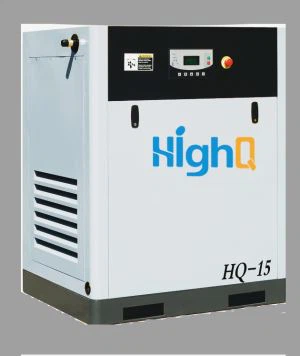
If you’re in the market for a dry oil-free screw air compressor, or you’re tired of dealing with a unit that keeps shutting down or wasting energy, let’s chat. I can walk you through the right setup for your facility, answer any questions about belts or specs, and make sure you get a unit that runs smoothly for years. No pushy sales talk, just real advice from someone who’s been in this game long enough to know what actually works.
Compressor Parts References:
- Compressed Air Challenge Fundamentals of Compressed Air Systems, 2021 Edition
- API Standard 619, Rotary-Type Positive Displacement Compressors for Petroleum, Chemical, and Gas Industry Services, 5th Edition
- Gardner Denver Technical Manual: Dry Screw Compressor Design & Efficiency, 2022
Xiamen HighQ Compressor Co., Ltd.
With over 20 years’ experience, Xiamen HighQ Compressor Co., Ltd. is one of the most professional dry oil free screw air compressor manufacturers and suppliers in China. We warmly welcome you to buy high quality dry oil free screw air compressor made in China from our factory. Good service and punctual delivery are available.
Address: 7th F. No.704 Yi Hua Center Xiamen China 361100
E-mail: vincent@hqcompressor.com
WebSite: https://www.hqcompressor.com/
